Diving in Bohol, Philippines: Your Ultimate Guide and My Personal Experience
This article may contain affiliate links. This means we receive a small commission whenever you book or purchase something through our links (at no extra cost to you!). You can find more information in our disclaimer.
The Chocolate Hills are cool in Bohol, but did you know that this island has an amazing underwater scene too?

I had the chance to visit Bohol last summer and one of my main goals for my trip was to dive at one of the province’s diving sites – the Napaling Reef.
In this guide, I’ll focus and share my freediving experience with the school of Sardines and in the Napaling Crack.
Not to mention my itchy experience with the jellyfish! 🪼
Whether you’re a seasoned freediver or a curious first-timer, this guide will equip you with everything you need to know to plan your diving trip to Bohol in 2026. 😉
How to Plan Your Diving in Bohol Trip in 2026?
🗓️ Best Time to Visit Bohol for Diving
The best time to visit Bohol for diving depends on your priorities. The dry season, from March to May has the calmest seas and best visibility and is ideal for both freediving and scuba diving.
However, this peak season can also mean higher prices and larger crowds.
The shoulder months (June and February) have a good balance between decent weather and fewer crowds.
📢 Pro Tip: Be mindful of jellyfish season, which can occur during the Philippines summer season (April to May).
We visited Bohol in the last week of April and although the crowd in Tagbilaran was manageable, Panglao’s mass was really different!
Not to mention that there were A LOT of tourists on the island.

Sign up now to grab your FREE guide to 50 hidden gems in the Philippines!
📍 Where are the Best Diving Spots in Bohol?
🏝️ Panglao Island

Panglao Island is a fantastic choice for both beginner and experienced divers.
Because of its proximity to Tagbilaran, it offers easy access to numerous dive sites especially if your port of entry is the Tagbilaran Sea Port.
📢 Join the community! Make sure you join our Philippines Hidden Gems – Travel Community. This is the place to ask any questions about your trip, to be inspired, and to connect with other Philippines travelers. Click here to join!
The dive spots here cater to a variety of skill levels from gentle coral gardens teeming with colorful fish to exhilarating drift dives for seasoned adventurers.
Alona Beach, the main tourist hub on Panglao, has a plethora of dive shops and beachfront resorts for different types of divers.
🏝️ Balicasag Island

This island is a haven for beginner and intermediate divers who seek calm waters and beautiful coral reefs.
It is also famous for its dramatic wall dives, where coral reefs drop off sharply into the deep blue.
The gentle currents around Balicasag make it a favorite spot for sea turtles and the “Black Forest” dive site is a must-do for experienced divers.
It features a unique ecosystem with abundant black coral trees.
🏝️ Cabilao Island

Calling all experienced divers looking for a more remote and pristine diving experience!
This island’s healthy coral reefs and diverse marine life is waiting for you. Schools of barracuda, jacks, and the occasional hammerhead shark can be encountered in these waters.
The currents around Cabilao can be stronger compared to other dive sites in Bohol, so it may be suitable for experienced divers comfortable navigating currents.
Cabilao Island also offers a more rustic and off-the-beaten-path experience compared to Panglao.
🏝️ Pamilacan Island

Pamilacan Island is a dream destination for divers and marine life enthusiasts of all levels.
This island is a haven for dolphin and whale shark watching, particularly during the season between November and May.
Beyond the exciting encounters with these gentle giants, Pamilacan also has beautiful coral reefs teeming with fish life.
If you’re fond of taking underwater photography, you will have a good chance of spotting manta rays here!
The laid-back atmosphere and focus on marine conservation also elevate the charm of Pamilacan Island.
⚠️ Important Update: As of June 2025, water activities around Pamilacan Island—such as snorkeling and dolphin watching—are temporarily suspended due to a recent incident. Please check with local tour operators for the latest updates before your trip.
🏝️ Anda Reefs

Experienced divers looking for a secluded underwater adventure should consider the Anda Reefs. Just some distance from Anda Beach in Bohol.
Located on the east coast of Bohol, Anda has stunning coral formations and excellent visibility. The dive sites here are less crowded than Panglao and Balicasag that offers you a more intimate experience.
Several Anda resorts also offer diving classes and dive tours around the area. However, the currents can be unpredictable, so it’s recommended for experienced divers comfortable navigating currents.
🐟 How to Choose a Guide or Diving Operator?

Choosing a reputable dive operator is paramount for a safe and unforgettable diving experience in Bohol. Here are some key factors to consider when choosing a guide or diving operator:
✅ PADI, SSI, AIDA, or Molchanovs Certification
This may be the most important factor to consider.
Therefore, ensure that the dive operator you choose is certified by a recognized diving organization like PADI (Professional Association of Diving Instructors), SSI (Scuba Schools International), AIDA (Association Internationale pour le Développement de l’Apnée), or Molchanovs.
This certification signifies that the operator adheres to internationally recognized safety standards and training protocols for scuba diving and freediving.
✅ Experienced and Qualified Staff
Opt for dive operators with experienced dive guides and instructors. Look for details about their qualifications and experience on their website or ask directly.
Ideally, the guides should be familiar with the specific dive sites you’re interested in and comfortable navigating local conditions.
✅ Freediving Expertise (if applicable)
If you’re specifically interested in freediving, make sure that the operator offers freediving courses and has instructors trained in freediving safety protocols.
These protocols differ from scuba diving and require specialized knowledge to ensure your safety underwater.
✅ Good Reviews and Recommendations
In today’s digital age,
Online reviews are a valuable resource in today’s digital age. After all, word-of-mouth recommendations can make or break a business.
So, read reviews on platforms like Tripadvisor, Google, or social media such as Facebook to see what past divers have experienced with different operators in Bohol.
Look for comments about safety standards, the professionalism of the staff, and the overall diving experience. You can also ask for recommendations from fellow divers.
📢 Don’t be afraid to ask questions! A responsible operator will be happy to address any concerns you have about safety, equipment, or dive sites.
A Beginner’s Guide to Freediving in Bohol

Freediving, also known as apnea diving, allows you to explore the underwater world while holding your breath. Yup! Just like what you’re thinking now.
It’s a fantastic way to connect with the ocean and experience the silence and serenity below the surface.
Freediving in Bohol was an unforgettable experience I had with my friend last summer. It was one for the book but I’ll talk more of that later.
For now, here are some of the things you need to know about freediving:
📍 Where is the Best Freediving Spot in Bohol?

Many dive sites around Bohol can be excellent for freediving!
It includes Balicasag Island, Anda Reefs, and Cabilao Island. However, a popular choice for some freedivers is the Napaling Reef and Sardines Run.
Napaling Reef, located on Panglao Island, has a shallow reef wall that starts just a few kicks from the shore that makes it easily accessible for freedivers.
The vibrant coral formations and diverse marine life here create a stunning underwater scene. But be aware that there’s a resort entrance fee for accessing the reef.
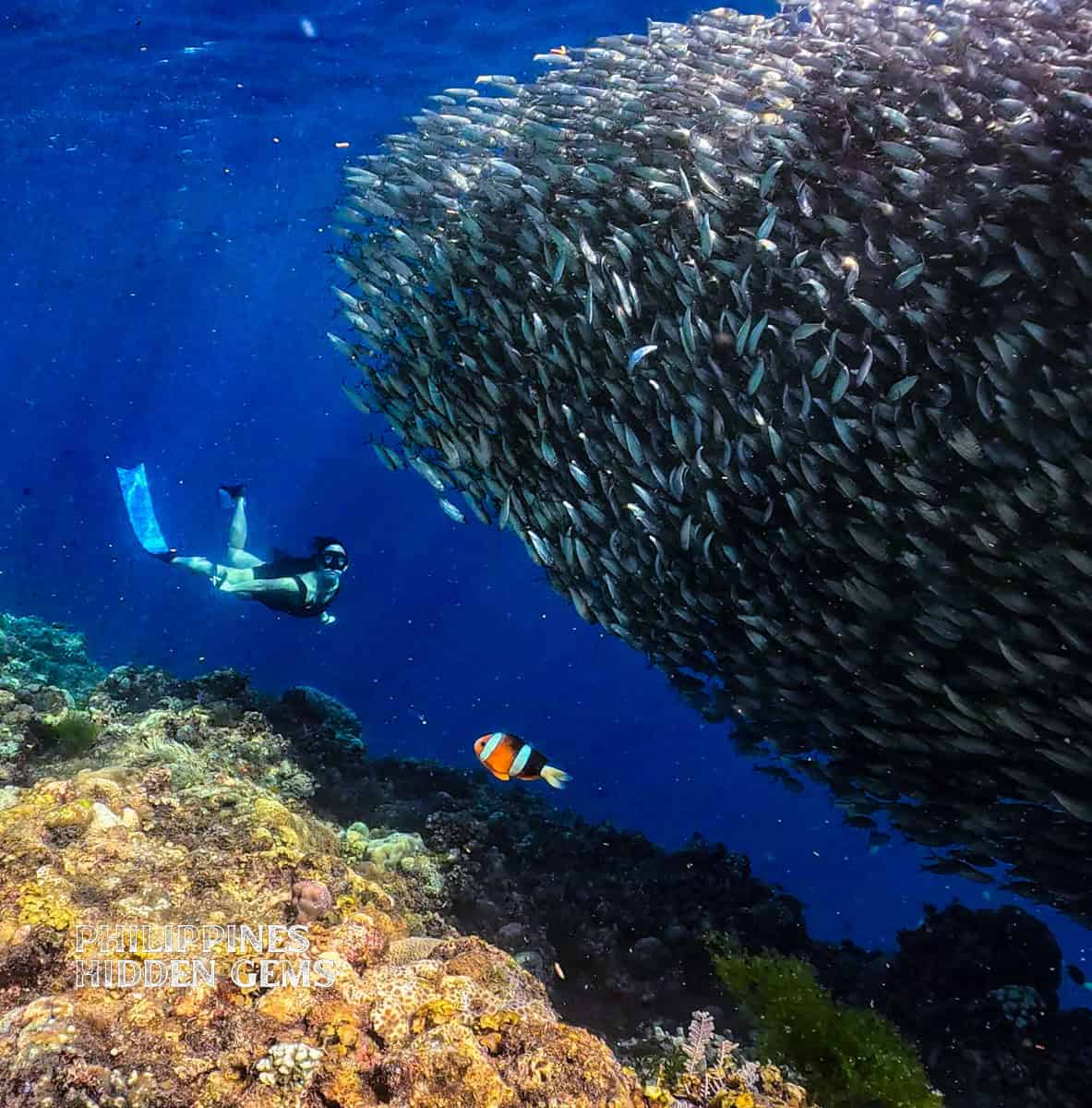
An added perk of this site is the chance to witness the Sardine Run!
An amazing seasonal phenomenon that typically occurs between November and May, where millions of sardines gather in a swirling mass, creating a mesmerizing underwater spectacle.
Just like the photo above!
📚 Freediving Courses and Training

If you’re new to freediving, I would highly recommend taking a course or a basic class.
A qualified instructor can teach you proper breathing techniques, equalization (clearing your ears), safety protocols, and rescue techniques.
Many dive operators in Bohol offer freediving courses for beginners and advanced divers.
As for me, I had my freediving intro class in Lawud Freediving, one of the diving centers in my hometown, last December 2023.
Even though I already have experience in freediving since 2022 (as a hobby), that class solidified some of my skills and cleared up my confusion with the help of my certified instructor.
While freediving without prior training is possible, having a certified guide or a buddy is essential for safety, and a plus if they know how to take awesome pictures of you underwater!
🤿 Necessary Freediving Equipment

✅ Mask: Choose a low-volume mask for a comfortable fit and clear vision.
✅ Freediving Fins: Unlike scuba diving fins, freediving fins are longer and stiffer, designed for powerful kicks that propel you through the water with minimal effort.
✅ Buoy and Safety Line: This is essential for safety, allowing your dive buddy to track your location underwater and signal to boats on the surface.
✅ Wetsuit (optional): A thin wetsuit can help regulate your body temperature, especially in deeper dives. But a rash guard will also do.
✅ Weight Belt (optional): If you want to freedive effortlessly, a weight belt with adjustable weights helps you achieve neutral buoyancy underwater.
⛑️ Safety Tips for Freediving
👉🏻 Buddy Up, Always: This is the golden rule of freediving. Never freedive alone. A buddy can keep an eye on you underwater, monitor your ascent, and assist you in case of emergencies. Make sure your buddy is also familiar with freediving safety protocols and emergency procedures.
👉🏻 Know Your Limits: Don’t be tempted to exceed your comfort zone or training level. It’s important to be honest with yourself about your limits and abilities. Ascend slowly and pay attention to your body’s signals. If you feel any discomfort, such as ear pain, dizziness, or lightheadedness, ascend immediately. There’s no shame in ending a dive early – your safety comes first.
👉🏻 Equalize Regularly: As you descend underwater, the pressure increases. To avoid ear pain and potential ear damage, it’s crucial to equalize your ear pressure frequently. There are various equalization techniques, like the Valsalva maneuver or Frenzel maneuver. Learn the technique that works best for you and practice it regularly before your dive.
👉🏻 Be Aware of Your Surroundings: Before entering the water, check the current conditions and avoid diving in areas with strong currents or heavy boat traffic. Strong currents can easily pull you off course and make it difficult to ascend safely. Similarly, busy boat traffic areas pose a risk of collision.
👉🏻 Breathe Easy, Avoid Hyperventilation: Some beginners mistakenly believe hyperventilating (taking rapid, deep breaths) before a dive will extend their bottom time. However, this is a dangerous practice that can lead to blackout – losing consciousness underwater. Focus on slow, relaxed breathing before and during your dive.
👉🏻 Be Prepared for Emergencies: Familiarize yourself with freediving rescue techniques, such as buddy rescue procedures and freediving blackout management. It’s also wise to have a plan in case of an emergency, including knowing the location of the nearest recompression chamber (in case of serious decompression illness).
🤝 Freediving Etiquette

🪸 Minimize Your Impact
The underwater world is a delicate ecosystem. Respect the coral reefs and marine life by avoiding any contact.
Your fins can easily damage coral, so practice good buoyancy control and stay clear of fragile coral formations.
Remember, even seemingly small actions can have a lasting impact on the environment.
🪸 Master Buoyancy Control
Being able to control your buoyancy underwater is crucial for both safety and reef conservation. Freediving allows you to move through the water with minimal disturbance.
Practice proper weighting and finning techniques to glide effortlessly without bumping into the coral or stirring up sediment.
🪸 Share the Underwater World
Bohol’s dive sites are popular for a reason. It’s possible to encounter other freedivers or scuba divers while exploring the reefs.
Be mindful of their presence and avoid crowding them. Maintain a safe distance and signal your presence if necessary.
Remember, patience and courtesy go a long way in ensuring a pleasant experience for everyone.
🪸 Respect Local Regulations
Different dive sites in Bohol may have specific regulations or restrictions for freedivers or even scuba divers.
Before entering the water, be sure to check for any local guidelines or signage regarding freediving in that particular area.
Following these regulations helps protect the marine environment and ensures the safety of all divers.
My Personal Experience of Freediving in Bohol

Last summer, my friend and I decided to tick freediving in Bohol off our bucket list, and it did not disappoint!
Just like other divers, both scuba divers and freedivers, we chose the Napaling Reef and Sardines Run as one of our activities to do in Bohol.
We hit the road early and went to the diving site with our rented motorcycle from Alona Pawikan.
We wanted to beat the crowds – not just the tourists snorkeling and freediving, but even other freedivers!
An early start meant we practically had Napaling Reef all to ourselves. But not really since some are way earlier than us haha! 🤭
Before the dive started, we contacted a dive shop, Bohol Freediving Gears, where we originally intended to rent long fins only but when we inquired if they had a Napaling fundive tour, they offered us a sweet package that included leaderfins, mask and snorkel, underwater videographer, all resort fees, and most importantly, a safety diver!

The first dive in itself was unreal. The water was crystal clear that you could even see the school of sardines up above the resort.
Other colorful fishes were also darting everywhere you looked.
But then, the real magic happened when we swam with this massive swirling school of sardines!
Our guide told us that these sardines actually stick around Napaling Reef and guarded by the Bureau of Fisheries and Aquatic Resources (BFAR) to make sure no one tries to fish them.
Swimming through that living, breathing silver cloud was like nothing I’d ever experienced!


The highlight of the trip, however, was definitely the Napaling Crack (a typical freediver’s item in the bucket list).
This underwater crevice was like a secret world hidden beneath the surface.
Sunlight streamed through the water, casting beams that lit up the whole place. It felt like we were swimming straight into a movie scene!
Although my deepest record was 10 meters only, diving the first time near the crack is like being enveloped with pressure. Kinda needs to improve my breath hold and to be honest it was my comeback dive after my intro class (so a little rusty).
I’m lucky that I know how to equalize because the scenery you’ll see is something that can’t be justified just by words!
We did get a bit unlucky and brushed against some jellyfish during the dive, which left some stings. Honestly though, it was a small price to pay for such an incredible adventure.
The whole experience was mind-blowing, and those little stings are just a funny story to tell now!
Freediving in Bohol wasn’t just about pushing my limits; it was about connecting with the ocean on a deeper level.
The experience fostered a sense of peace and tranquility that leaves me with a newfound appreciation for the beauty and fragility of the underwater world.
Exploring Bohol’s Underwater World Beyond Freediving

🥽 Scuba Diving in Bohol
For those who prefer to explore with the aid of a scuba tank, Bohol offers incredible scuba diving opportunities.
The rich coral reefs around Balicasag Island and Pamilacan Island are teeming with marine life, including sharks, barracuda, and even the occasional manta ray.
Several dive sites cater to different experience levels, from gentle coral gardens to exhilarating wall dives.
🏝️ Snorkeling and Island Hopping
For a more relaxed underwater experience, snorkeling is a fantastic option.
Many dive operators offer snorkeling trips to beautiful coral reefs, allowing you to observe the underwater world without needing special equipment.
Island hopping tours in Bohol are another great way to explore the island’s stunning coastline and discover hidden coves and beaches.
You can often combine snorkeling with island hopping for a full day of adventure.
How to Get to Bohol, Philippines?

Bohol is easily accessible from various points in the Philippines.
The Bohol-Panglao International Airport receives daily flights from major Philippine cities like Manila, Cebu, and Davao and other countries like South Korea.
Alternatively, you can also reach Bohol by ferry from Cebu, Dumaguete, Siquijor, or nearby islands.
Where to Stay in Bohol (Panglao Island)?
🏖️ Budget Stay: Alona Pawikan

If you’re looking for a comfortable, convenient, and affordable place to stay on Panglao Island, Bohol, then Alona Pawikan might be the perfect spot for you.
This resort offers a laid-back atmosphere with clean, individually furnished bungalows. The rooms come with air-conditioning, comfortable beds, and essential amenities like a minibar and free bottled water.
It’s conveniently situated just a stone’s throw away from the famous Alona Beach. The resort also offers laundry services, motorbike rentals for, and on-site dining with a range of light and heavier fare to choose from.
🏖️ Mid-range Accommodation: Pyramid Beach Resort
Pyramid Beach Resort offers a good balance between comfort and affordability for travelers visiting Panglao Island.
This resort has a beachfront location, perfect for those who want to wake up to the sound of waves and stroll directly onto the sand.
The rooms come with balconies or terraces, and you can choose from a variety of room options, including air-conditioned rooms, a swimming pool, a restaurant serving delicious meals, and a bar to unwind with a drink.
The resort also offers activities like kayaking and billiards for some entertainment during your stay.
🏖️ Luxurious Resort: Oceanica Resort Panglao

Oceanica Resort Panglao, formerly known as South Palms Resort, promises you a luxurious escape on the island.
This resort offers stunning beachfront villas and suites, perfect for those seeking a pampered stay.
You can imagine soaking in a private infinity pool overlooking the crystal-clear ocean or relaxing on a plush lounge chair on your private terrace.
The resort boasts a variety of restaurants serving international cuisine, a spa offering indulgent treatments, and several swimming pools to choose from.
What to Pack Before Diving in Bohol?
🩱 Swimsuit and Rashguard: Opt for a well-fitting swimsuit and a rashguard for sun protection.
🧖🏻♀️ Towel: Bring a quick-drying towel for drying off after dives.
🧢 Sunscreen and Hat: Pack reef-safe sunscreen and a hat to protect yourself from the sun.
🩴 Flip flops or Water Shoes: These are essential for walking on the beach and boat decks.
📷 Underwater Camera (optional): Capture your underwater adventures with a waterproof camera.
🥤 Reusable Water Bottle: Stay hydrated throughout your trip with a reusable water bottle.
🩹 Basic First-Aid Kit: Pack a small first-aid kit with essential supplies like bandages and antiseptic wipes.
💊 Medications: Bring any necessary medications you require.
💸 Cash and Credit Card: While many establishments accept credit cards, it’s wise to carry some cash for smaller purchases and emergencies.
Final Thoughts on My Experience of Diving in Bohol

Was diving in Bohol worth it? DEFINITELY!
Freediving in Bohol was an unforgettable experience that left a lasting impression on me.
It was a unique blend of adventure, self-discovery that I could endure some physical sensations (pressure and stings), and a newfound appreciation for the beauty of the underwater ecosystem.
If you ask me if I want to do diving in Bohol again, I would say YES immediately!
🏝️ Travel Resources for Your Bohol Trip
Planning a trip to Bohol? Here’s a quick list of trusted websites to book everything you need—flights, ferries, hotels, tours, transportation, and more.
How to Get to Bohol – Use 12Go to book ferries to Bohol from Cebu, Siquijor, or Dumaguete, or search flights to Panglao’s Bohol-Panglao International Airport.
Where to Book Your Stay – Browse top-rated resorts, beachfront stays, and budget-friendly options on Booking.com, Agoda, Airbnb, or Vrbo if you’re traveling with family or in a group.
Getting Around the Island – Book a self-driving car via Rentalcars.com or Discovercars.com, rent a scooter locally (₱400–₱600/day), use a taxi, tuktuk, bus, or hire a private driver for day tours and airport transfers.
Book Tours and Activities – Discover Chocolate Hills, island hopping, and tarsier sanctuaries through Klook, Viator, or GetYourGuide, or book directly with local operators in Panglao or Tagbilaran.
Stay Connected – Use an Airalo eSIM for reliable data, rent pocket WiFi from Klook if you’re in a group, or grab a Globe or Smart SIM card before you arrive.
Cash, ATMs, and Payments – Bring pesos for local shops and tours, as small towns may not accept cards, and some ATMs can run out of cash on weekends or holidays.
Travel Insurance – Get coverage for health, accidents, or delays from SafetyWing, HeyMondo, or World Nomads, especially if you plan to drive or join water activities.
Check Out These Recommended Articles:
- 7 Best Beaches in Bohol (+3 Must-Visit Islands)
- 20 Best Activities & Tourist Spots in Bohol You Can’t-Miss
- Alona Beach in Bohol Philippines: Everything You Need to Know
- Why You Should Visit Anda Beach Bohol Philippines?
- Top Beaches in Panglao Island Bohol: Your Guide to the Best Spots
- Chocolate Hills of Bohol Philippines: Your Ultimate Travel Guide
- Your Bohol Itinerary: What to See and Do in 3 – 5 Days
- 5 Best Bohol Tours You Need to Try
- Master the Art of Diving in the Philippines’ Secret Spots

About the Author
Hi! I’m Kristine (aka KR). I’m the main developer of Philippine Hidden Gems. My work includes going to places to cover events and places that I’m happy to share with the readers.
Even though I’m an introvert who loves to read and stay indoors all the time, I love to travel outside the country (at least once a year) and nearby regions within PH.
My recent hobbies include learning Japanese culture and exploring the world of K-Pop as a Carat.